


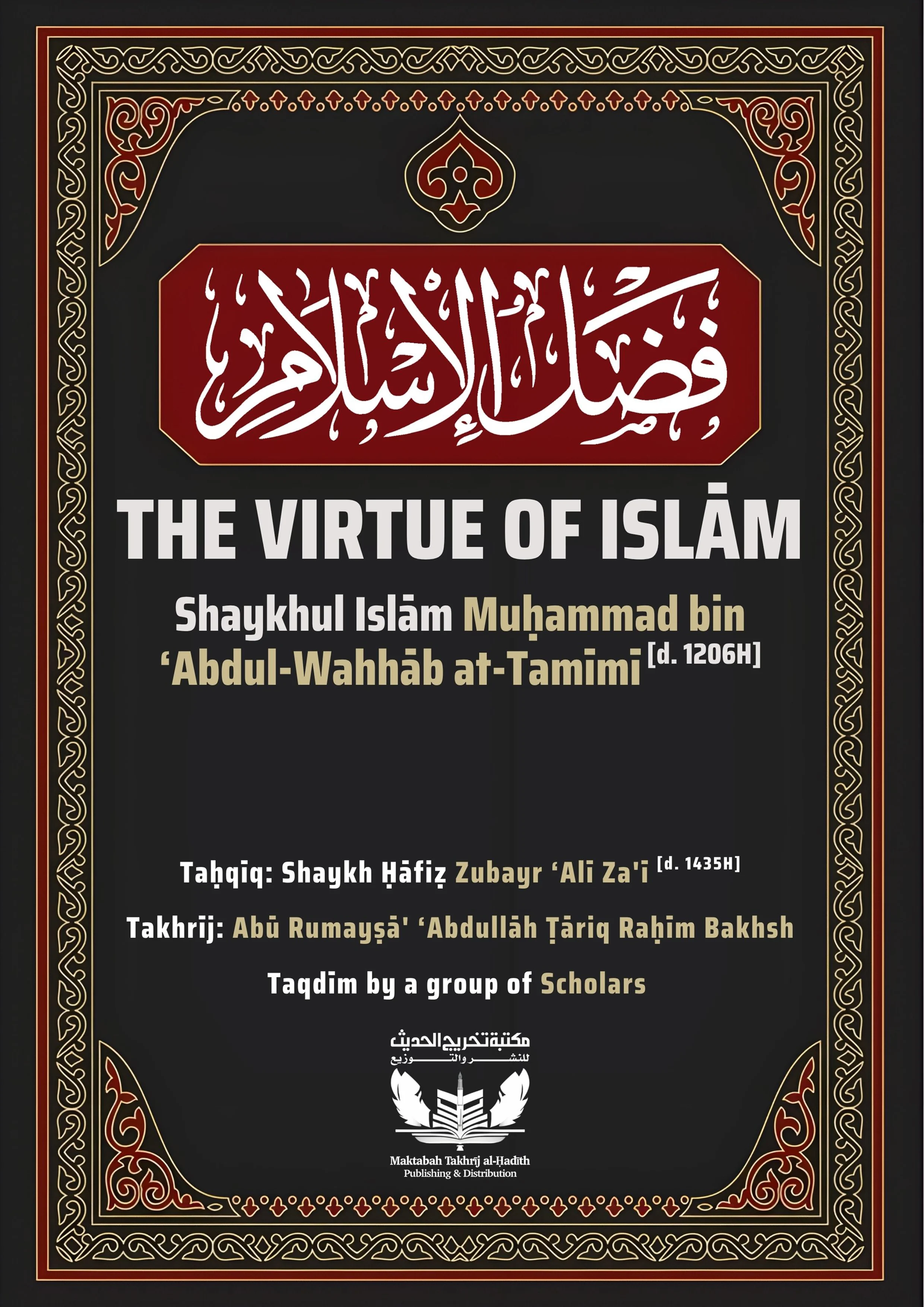
A timeless classic, now accessible in English. The Virtue of Islām (Faḍlul-Islām) by Shaykhul Islām Muḥammad bin ‘Abdul-Wahhāb at-Tamīmī is a concise yet profound treatise exploring the distinctive characteristics and unparalleled blessings of Islām over other religions. Each chapter invites deep reflection, backed by scholarly proofs. This edition is enriched with the authentication of Shaykh Ḥāfiẓ Zubayr ‘Alī Za’ī, the original Arabic matn with tashkīl [āyāt and aḥādīth], and a revised English translation – making it ideal for both self-study and following along with scholarly explanations. Scholar-endorsed and carefully edited with extensive additional takhrīj by Abū Rumayṣā’ ‘Abdullāh Ṭāriq Raḥīm Bakhsh.
The Virtue of Islām
11.99 $
Description
Before you is the English rendition of the treatise “The virtue of Islām” (Faḍlul-Islām) by Shaykhul Islām Muḥammad bin Abdul-Wahhāb at-Tamīmī. This concise book contains the distinctive characteristics of Islām, and if someone ponders over each chapter and the proofs mentioned within it, he will be able to recognize many of the great blessings of Islām and its merit over other religions. This book is one that rewards reflection and contemplation, so each chapter should be accompanied by such.
Chapters of the book:
Chapter [1]: The virtue of Islām
Chapter [2]: The obligation of [adhering to] Islām
Chapter [3]: The interpretation of Islām
Chapter [4]: The statement of Allāh: “And whoever desires other than Islām as religion – never will it be accepted from him, and he, in the Hereafter, will be among the losers.” [Sūrah āl-‘Imrān 3: 85]
Chapter [5]: The obligation of sufficing with following, i.e., the Qurān
Chapter [6]: What has been mentioned about attributing oneself to other than Islām
Chapter [7]: The obligation to enter Islām completely and to abandon everything else
Chapter [8]: What has been mentioned regarding innovating [in the religion] is worse than a major sin
Chapter [9]: What has been mentioned regarding Allāh withholding repentance from the person of bid’ah
Chapter [10]: The statement of Allāh – the Exalted: “O People of the Scripture, why do you argue about Ibrāhīm” [Sūrah āl-‘Imrān 3: 65]
Chapter [11]: The statement of Allāh – the Exalted: “So direct your face [i.e., self] toward the religion, inclining to truth” [Sūrah ar-Rūm 30: 30]
Chapter [12]: What has been mentioned regarding the strangeness of Islām and the virtue of the strangers
Chapter [13]: Warning against innovating [in the religion]
Additional information
| Author: | Shaykhul Islām Muḥammad bin Abdul-Wahhāb at-Tamīmī |
|---|---|
| Taḥqīq: | Shaykh Ḥāfiẓ Zubayr ‘Alī Za'ī |
| Takhrīj: | Abū Rumayṣā' ‘Abdullāh Ṭāriq Raḥīm Bakhsh |
| Taqdīm: | • Shaykh Dr. Nadhīr Aḥmad ‘Umrī Madanī |
| Language: | English |
| Edition: | • First [May-2022 / Shawwāl 1443H] |
| Pages: | 147 |
| ISBN: | 979-818133797 |
| Binding: | Softcover |
Āsiyah [Bosnia] –
Assalāmu ‘alaykum,
Alḥamdulillāh, by the mercy of Allāh, I had the honor to read this book and I really loved it. The work that was put into it is definitely enormous as the takhrīj speaks for itself. As someone who loves everything about ‘aqīdah and someone who is learning about the dīn, this is a great work that benefits the beginner but also advanced level of seeker of knowledge because the knowledge within the book, especially for those who love science of ḥadīth, is vast. Apart from that, I really love the font. It’s so much easier to read when you have a bit bigger font alḥamdulillāh.
I ask Allāh to reward everyone who worked on it abundantly and to reward Shaykh Muḥammad bin ‘Abdul-Wahhāb with the highest level of Jannah. Āmīn.
Abū Fāṭimah [Authentic Quotes], Riyadh, Kingdom of Saudi Arabia –
I highly recommend “The virtue of Islām (Faḍl-ul-Islām)” to anyone seeking a concise yet deeply beneficial work on the excellence of Islām. Despite its brief length, every chapter is rich with authentic evidences from the Qurān and sunnah, encouraging sincere reflection on the unique virtues and blessings of this religion.
This English edition is exceptionally well produced. The revised translation is clear and easy to follow, while the inclusion of the original Arabic text with tashkīl makes it valuable for both students of knowledge and those wishing to study alongside scholarly explanations. The authentication by Shaykh Ḥāfiẓ Zubayr ‘Alī Za’ī and the extensive takhrīj further enhances its reliability.
A beautifully presented, scholarly, and accessible work. May Allāh reward everyone involved in bringing this beneficial book to the English-speaking audience.
‘Abdullāh –
A concise yet immensely beneficial book highlighting the virtues of Islām through authentic Qurān and sunnah evidences.
It is beautifully translated, well-authenticated, and thoughtfully presented with Arabic text.
Dr. Kashaf Raza [New Delhi, India] –
Alḥamdulillāh, I really enjoyed reading “The virtue of Islām (Faḍl-ul-Islām)”. Even though it’s a short book, it’s packed with beneficial reminders and authentic proofs from the Qurān and sunnah. The English translation is clear and easy to understand. May Allāh reward everyone involved with this book. I highly recommend it to anyone who wants to learn more about the beauty and virtues of Islām.
Abul-‘Āliyah [a graduate from Islāmic University of Madinah], Victoria, Australia. –
“The virtue of Islām (Faḍl-ul-Islām)” is a concise but powerful treatise that highlights the excellence and unique virtues of Islām as the only religion accepted by Allāh. The author gathers Qurānic āyāt and authentic aḥādīth to demonstrate the obligation of adhering to pure Islām, holding firmly to the sunnah, and avoiding innovations (bid’ah), sectarianism, and blind following that contradicts revelation.
One of the book’s central themes is that true honor, guidance, and salvation are found only through sincere submission to Allāh and following the Prophet upon the understanding of the salaf. The style is simple and evidence-based, making it accessible while remaining deeply beneficial.
Overall, it is an excellent introductory work for anyone seeking to understand the virtue of Islām, the importance of preserving its purity, and the danger of deviating from the straight path. It is especially valuable when studied with a reliable scholarly explanation, as many of its chapters contain profound principles despite their brevity.
Junayd Anṣārī [Aurangabad, India] –
Assalāmu ‘alaykum,
Translation is precise, print quality, pages, content is good.
The book is a worth read for beginners as well as those who are firmly grounded in knowledge.
Bārakallāhu fīkum for all the efforts put in to make it available for those who do not understand Arabic well.
Abū Ḥamzah Yāsir Arshad [Dār Abī Yāsir] [Toba Tek Singh, Pakistan] –
The book gives a refined finish, typical to Dārussalām standards – I particularly enjoyed the extensive takhrīj upon this critically acclaimed yet simplistic text. I was surprised to see the takhrīj (cross-referencing from the corpus of ḥadīth literature) involved muḥaddith Muqbil from Yemen and Shaykh Dr. Muḥammad ‘Abdullāh al-‘Aẓamī [i.e., Ḍiyā’], author of al-Jāmi’ al-Kāmil – A ḥadīth encyclopedia of marfū’ aḥādīth only. This was very pleasing to me. I cherish knowing if what I am reading is authentic, so I thank Abū Rumayṣā’ heartily (jazāhullahu khayran) … as for the text; it needs no introduction, the work is by a mujaddid.
Hārūn Rafīq Shāh [Kashmir, India] –
Assalāmu ‘alaykum wa raḥmatullāh,
I have read this edition of “The virtue of Islām (Faḍl-ul-Islām)” by Shaykhul Islām Muḥammad bin ‘Abdul-Wahhāb at-Tamīmī, and can say with absolute certainty that it is a work that deserves to be in every household. It is quickly spanned, but every line rests on the Qurān and the sunnah, calling the reader back to Islām as it truly is.
What stands out most is the taḥqīq. This edition stands upon the verification of Shaykh Ḥāfiẓ Zubayr ‘Alī Za’ī, a service he had already rendered to this book, and my beloved brother Abū Rumayṣā’ (may Allāh preserve him) has taken it further with research of his own. He has weighed the gradings against the verdicts of Shaykh Aḥmad Muḥammad Shākir, Shaykh Muqbil bin Hādī, Shaykh Muḥammad Nāṣir-ud-Dīn al-Albānī, Shaykh ‘Abdul-Qādir al-Arna’ūṭ, Shaykh Shu’ayb al-Arna’ūṭ, and others, and wherever they differed, he has said so plainly rather than picking one view and staying quiet about the rest. He has also gone back to the books of asmā’ and rijāl for the narrators discussed throughout, so the reader is not left to take a grading on trust alone but can clearly see the men behind each chain.
It is this same care that carries through to the rest of the edition in Arabic, with full tashkīl sits beside a translation reliable enough to be trusted on its own, so the book serves the beginner and the one further along equally well.
May Allāh reward my brother Abū Rumayṣā’ and everyone who worked on this book, and make it a means of guidance for everyone who reads it as it were for me.
Abū ‘Umar al-Hindī as-Salafī [Jeddah, Saudi Arabia] –
In the name of Allāh, the Most Beneficent, the Most Merciful,
The original text in Arabic is from one of the most crucial and beneficial books to understand the importance of following the sunnah in all matters especially in the methodology of calling people towards the truth and other related matters.
Thankfully, the translation and publication by Maktabah Takhrīj al-Ḥadīth has served well the original text. May Allāh bless them and have mercy on the author.
The book is full of short and comprehensive footnotes and formatted in a beautiful format for anyone wanting to read or study this book. And Allāh knows best.
‘Uzayr Khān [Mumbai, India] –
→ A timely call to pure Islām:
“The virtue of Islām (Faḍl-ul-Islām)” by Shaykhul Islām Muḥammad bin ‘Abdul-Wahhāb is not merely a concise treatise on the merits of Islām. It is a concentrated call to the very reality of Islām: Sincere submission to Allāh alone, adherence to the guidance brought by His Messenger, and freedom from every path, practice, allegiance, or claim that compromises the purity and completeness of that submission.
As one who holds firmly to the old-school ahlul-ḥadīth methodology, I found this work to be deeply familiar in its spirit and decisive in its direction. Its strength lies in its refusal to make the religion subordinate to personal inclinations, inherited customs, sectarian loyalties, or later speculative preferences. Rather, it repeatedly returns the reader to the only secure foundation: The Book of Allāh, the authentic sunnah of His Messenger, and the understanding and way of the righteous predecessors.
This is the methodology that I value above my own preference. A person may have attachments, habits, cultural assumptions, or long-held views; but when the clear evidence of the Qurān and sunnah becomes manifest, the believer’s duty is not to defend himself, his group, or his taste. His duty is to submit. Faḍlul-Islām restores that essential meaning of submission with unusual clarity and force.
→ A continuation of foundational study:
My own journey toward a clearer understanding of tawḥīd was shaped profoundly by foundational works such as Kitāb at-Tawḥīd of Shaykh Muḥammad bin ‘Abdul-Wahhāb, Taqwiyatul-Īmān of Shāh Ismā‘īl Dehlawī, Ad-Dīn al-Khāliṣ, and Asāsiyyāt al-Islām. These books did not present tawḥīd as an abstract theological topic detached from life; they taught it as the basis of one’s worship, loyalty, fear, hope, obedience, and ultimate salvation.
In that sense, The virtue of Islām serves as a natural and necessary companion to those works. If Kitāb at-Tawḥīd establishes the right of Allāh over His servants and exposes whatever violates or diminishes that right, then Faḍlul-Islām reminds the reader that Islām itself is the complete divinely approved path through which tawḥīd is lived, guarded, and preserved. It calls the Muslim to enter Islām wholly – not selectively – and to measure every religious claim by revelation rather than sentiment.
The book’s progression is particularly powerful. It begins with the virtue of Islām, then moves to its obligation and meaning, before addressing the necessity of holding fast to the revealed path, abandoning opposing ways, avoiding the claims of jāhiliyyah, and remaining alert to the dangers of bid‘ah. It concludes with the theme of the strangeness of Islām and the virtue of the strangers – an especially relevant reminder for anyone attempting to remain steadfast when truth is not always popular, convenient, or socially rewarded.
→ Methodology before preference:
The defining quality of this treatise is its manhaj. Shaykh Muḥammad bin ‘Abdul-Wahhāb does not ask the reader to adopt a personality, a slogan, or a partisan identity. He directs him to evidences. The reader is confronted with Qurānic āyāt, prophetic narrations, and reports from the salaf that establish the virtue of Islām, the requirement of following the straight path, and the grave danger of departing from the sunnah.
For an ahlul-ḥadīth reader, this is precisely where the book’s lasting value appears. True adherence to the sunnah is not merely the use of a label; it is the willingness to let the text govern one’s position. It means that the believer does not make his own desire a judge over the proof. Nor does he seek refuge in the sheer age of a practice, the popularity of a view, the standing of a community, or the emotional comfort of inherited customs when they conflict with clear guidance.
The book’s message is therefore both simple and demanding:
❶ Islām is not to be received partially while other systems of religious allegiance are retained beside it.
❷ The Qurān and sunnah are not to be treated as secondary to opinion, mysticism, group loyalty, cultural habit, or unexamined tradition.
❸ The sunnah is not a decorative addition to religion; it is the path by which the religion is understood, practiced, and protected.
❹ Innovation in religious matters is not harmless creativity. It risks altering the religion after its completion and displacing the guidance of the Messenger.
❺ Steadfastness upon the truth may bring loneliness, but the ‘strangers’ are not abandoned; their strangeness is a mark of remaining upon the prophetic path when others depart from it.
The concise statement attributed to Ubayy bin Ka‘b, cited in the work: ‘Moderation upon the sunnah is better than striving in that which opposes the path and the sunnah’ captures an entire methodology. A small deed founded upon correct creed, sincere intention, and prophetic guidance outweighs religious zeal built upon an unsound path.
→ Scholarly edition and editorial merit:
This second edition deserves recognition not only for the importance of the original treatise but also for the seriousness with which it has been prepared. The work is based upon the taḥqīq of Shaykh Ḥāfiẓ Zubayr ‘Alī Za’ī, whose concern for the principles of ḥadīth criticism and authentication is evident in the grading and sourcing of narrations. The present edition further expands the service of the text through additional takhrīj, comparative scholarly references, documentation of variant gradings where appropriate, updated citations, narrator references, and a systematic index of Qurānic āyāt, aḥādīth, āthār, and scholarly statements.
From the perspective of a book typesetter and editor who has worked with Islāmic texts, I appreciate that a publication of this kind must serve more than one category of reader. It must be approachable for the general Muslim, reliable for the student of knowledge, and usable for the researcher. This edition makes a commendable effort toward all three.
The inclusion of Arabic alongside English translation, the clear chapter divisions, the extensive footnotes, the identification of editorial additions, the provision of vowel markings for the cited aḥādīth, and the detailed indexes are not superficial publishing features. They are editorial decisions that strengthen access to the text while maintaining scholarly traceability. A reader can benefit from the book devotionally and practically; a student can follow the evidences; and a researcher can locate sources and assess discussions of authentication. The edition’s editorial foreword explicitly explains the method used in its additional takhrīj, including the treatment of areas where ḥadīth scholars agree, differ, or regard a report as disputed.
In Islāmic publishing, good typography and orderly presentation are themselves forms of service to knowledge. When the hierarchy of headings is clear, Arabic and translation are distinguishable, footnotes are disciplined, and reference apparatus is easy to navigate, the reader is helped to approach the text with attention rather than fatigue. This edition understands that a book of ‘aqīdah and manhaj should be presented with seriousness, restraint, legibility, and reverence.
The virtue of Islām is a small book with a weighty purpose. It should not be judged by its page count, because its subject is the foundation of every page a Muslim reads, every act of worship he performs, and every religious commitment he makes. It asks the reader a question that cannot be avoided: Is my religion built upon the revealed guidance of Allāh and His Messenger, as understood by the salaf, or upon preferences that I have learned to defend?
For those who have been nurtured by works such as Kitāb at-Tawḥīd, Taqwiyatul-Īmān, Ad-Dīn al-Khāliṣ, and Asāsiyyāt al-Islām, this treatise will feel like a return to the central principles that give those works their force: tawḥīd before all else, sunnah before opinion, evidence before personality, and submission before preference.
I recommend this book strongly to students of knowledge, callers to tawḥīd, teachers, editors and translators of Islāmic literature, and every Muslim who wishes to examine whether his attachment is to Islām as revealed or merely to the forms of religion that have become familiar to him. Read it slowly. Trace its evidences. Reflect on its warnings. And allow its central demand to correct the heart: That the religion of Allāh is more deserving of our loyalty than our own inclinations.
May Allāh reward the author, the muḥaqqiq, the translators, editors, proofreaders, and publishers who contributed to bringing this beneficial work to English-speaking readers. May He make it a means of strengthening tawḥīd, reviving attachment to the sunnah, protecting Muslims from deviation and innovation, and granting steadfastness upon the straight path until the day we meet Him.
Ibrāhīm al-Kūbī al-Atharī [Florida, USA] –
This newly revised edition of Faḍlul-Islām breathes critical academic depth into this foundational classical treatise. Though highly concise, this print stands out significantly due to its extensive taḥqīq and takhrīj. This edition serves as both a structured self-study guide and an academic reference, making it ideal for beginners and advanced students of knowledge alike.
The primary value of this edition lies in the integration of the late Shaykh Zubayr ‘Alī Za’ī’s meticulous ḥadīth authentications. The author, Shaykhul Islām Muḥammad bin ‘Abdul-Wahhāb, heavily structures his arguments around classical textual proofs. All the aḥādīth in this print are cited along with its reference and authentication.
For students of knowledge seeking a pristine, academically verified version of this classic text, this publication is arguably the definitive English edition on the market today. It eliminates the guesswork regarding narration authenticity while respecting the brevity of the original author’s intent.
May Allāh accept this work, showering His abundant blessings upon both its publishers and readers, and make it a source of enduring guidance and heavy on their scales of good deeds.
Yūsuf [Sweden] –
All praise be to Allāh, Lord of the Worlds. I had the pleasure to read the “The virtue of Islām (Faḍl-ul-Islām)” written by Shaykhul Islām Muḥammad bin ‘Abdul-Wahhāb at-Tamīmī. The book is concise, profound, and easy to understand for beginners. It explores the different virtues and blessings of Islām, backed up by prophetic traditions and Qurān āyāt. There is the emphasis on steadfastness and submitting to Allāh. What does submission mean? The book captures this concept beautifully. It reminds you of the danger of innovation and its consequences.
Dr. Nabīl Muṣṭafā al-Khayrī, [Teacher of ‘Aqīdah, Manhaj and Tafsīr al-Qurān | a preacher at the Ministry of Islāmic Affairs] [Bahrain] –
In the name of Allāh, the Most Beneficent, the Most Merciful,
Assalāmu ‘alaykum waraḥamatullāhi wabarakātuhu,
Alḥamdulillāh, all praise belongs to Allāh alone, and peace and blessings be upon His final Messenger, Muḥammad, upon his family, his companions, and all who follow his guidance until the Last Day. I do not begin this review as a formality, but because no words of my own could open a reflection on this book better than the words with which Allāh Himself opened the religion it speaks of.
I picked up “The virtue of Islām (Faḍl-ul-Islām)” by Shaykh-ul-Islām Muḥammad bin ‘Abdul-Wahhāb at-Tamīmī expecting a short treatise. I closed it a changed reader. It is, in truth, one of those rare small books that does not simply inform the mind but quietly rearranges the heart – and I do not say that lightly.
→ A book that does not flatter the reader – it awakens him:
What struck me first is how little this book asks you to take on trust. Chapter after chapter, the author lays the Qurān and the authentic sunnah directly before you and simply steps aside. There is no persuasion by rhetoric here, only the unanswerable weight of revelation: The āyah: “And whoever desires other than Islām as religion, never will it be accepted from him…” [Sūrah āl-‘Imrān 3: 85] placed beside the obligation of adhering to Islām completely, the warning against attributing oneself to other than it, and the sobering chapters on innovation and the withholding of repentance from its people. By the time the book turns, in its final pages, to the strangeness of Islām and the virtue of the strangers, you no longer read it as history. You read it as a mirror held up to your own life, asking quietly: Is my religion something I have inherited out of habit, or something I have actually submitted to?
This is why I believe the book deserves to be read again and again rather than once. The first reading humbles you. The second reading, you begin to notice how tightly every chapter is stitched to the one before it – virtue, then obligation, then meaning, then the danger of division, then steadfastness. Nothing in it is decorative. Every line is working.
→ An edition worthy of the treatise itself:
What elevates this particular edition beyond the text alone is the sheer care taken in its preparation. The taḥqīq of Shaykh Ḥāfiẓ Zubayr ‘Alī Za’ī rests on serious, careful scholarship, and Abū Rumayṣā’ has built on it with evident dedication. His additional research is extensive rather than performative: Gradings are weighed against the verdicts of scholars such as Shaykh Aḥmad Muḥammad Shākir, Shaykh Muqbil bin Hādī, Shaykh al-Albānī, and the Arna’ūṭ brothers, and – most refreshingly – points of disagreement among them are stated plainly rather than smoothed over. Full ḥarakāt on every ḥadīth, references to the books of asmā’ and rijāl, and a systematic index of every āyah, ḥadīth, athar, and scholarly statement mean this is not a book you merely read; it is a book you can study, verify, and return to as a reference for years.
The English translation deserves its own praise. It reads clearly and with dignity, never sacrificing precision for ease nor ease for precision, and the original Arabic sits beside it in full tashkīl – a gift to anyone wishing to engage the text at a deeper level. Add to this the generous font, the clean typesetting, and a layout that never crowds the reader, and what you hold is a volume that honors both the scholar and the beginner equally.
→ Why I am recommending this to everyone I know:
I am not writing this review to add a number to a page of reviews. I am writing it because I genuinely believe this small book has the power to reset a person’s entire relationship with their dīn – to strip away the parts of our practice that are cultural habit and leave standing only what Allāh and His Messenger actually commanded. Few books this short carry this much weight. Fewer still carry it this gracefully.
There is also a personal thread in this for me. I began seeking knowledge in 2013 under Shaykh Dr. Maḥbūb Abū ‘Āṣim, and it was moving to find, in this very edition’s foreword, that he is the same mentor Abū Rumayṣā’ thanks for guiding him through this taḥqīq. Teaching ‘aqīdah and manhaj myself here in Bahrain, I felt in these pages the same unmistakable method I was raised upon: Let the Qurān and sunnah speak first, and let everything else – habit, sentiment, inherited custom – answer to them. That is precisely what this book does, chapter after chapter, and it is why I will be placing it firmly on the reading list for my own students.
I ask Allāh to reward Shaykhul Islām Muḥammad bin ‘Abdul-Wahhāb with the best of rewards, to reward Shaykh Ḥāfiẓ Zubayr ‘Alī Za’ī and Abū Rumayṣā’ ‘Abdullāh Ṭāriq Raḥīm Bakhsh for their tremendous efforts in taḥqīq and takhrīj, and to reward everyone at Maktabah Takhrīj al-Ḥadīth who brought this second edition to English-speaking readers with such excellence. May He make this book a means of guidance for every hand it passes through, a means of reviving sincere submission to Him alone, and a witness in our favor on the Day we meet Him. Āmīn.
Read it once to be humbled. Read it again to be transformed. And keep it close, because a book like this is not finished with you after the first page – it never quite lets you go.
And Allāh knows best.
Faḍl Khān [Oakville, Ontario, Canada] –
This is an excellent bilingual edition, and the formatting is beautiful. You can really tell how much effort Abū Rumayṣā’ (may Allāh reward him) put into the translation, especially from the ḥadīth aspect. He even included thorough takhrīj (sourcing the narrations) along with gradings from numerous ḥadīth scholars.
Even though I am no expert in ḥadīth or this specific book, I honestly think this version gives Arabic editions a run for their money. Most of the Arabic copies I have seen generally don’t even contain takhrīj, let alone gradings of the ḥadīth!
Abū ‘Ubaydah Arsalān Yūnus [Ark of Knowledge Publications] [Leeds, England, UK] –
“The Virtue of Islām (Faḍl-ul-Islām)” is a short but concentrated Islāmic book on creed. The author builds his message largely by bringing together Qurānic āyat, aḥādīth, and statements from early scholars around a central theme: The virtue of adhering to Islām and the importance of remaining upon the Qurān and sunnah while avoiding religious innovation.
The second edition isn’t merely a reprint. The editor explains that he added detailed elements such as vowel markings to the aḥādīth, updated references, added narrator/rijāl references, incorporated additional scholarly gradings and created an index of the Qurānic āyāt, aḥādīth, āthār and quotations.
For someone who likes an evidence-based style, this is probably one of the book’s strongest features.
May Allāh reward all those involved in helping to produce this essential work and make it beneficial for all the Muslims.